



Two companies quote for your event. One says £4,000. The other says £14,000. Same event, on paper. What should you do?
Most UK agencies charge 10 to 20% of the total event budget, a fixed project fee, or a day rate of £450 to £700 for a senior event manager. A well produced half day conference and evening reception for 80 to 100 people at a quality London venue costs roughly £69,000 to £106,000, which is about £800 to £1,200 a head. A client workshop and dinner for 40 people can be delivered properly for £13,000 to £25,000. What follows is where that investment goes, and how to tell a fair quote from a thin one.
Where these numbers come from.
We get asked some version of this a lot, so here is the answer from the inside, and from an agency that deliberately sits in the middle of the market.
The figures in this article come from Legacy’s own benchmarking research. They are drawn from real budgets for events we have delivered, live quotes from our supplier and freelance network, and rates gathered across the markets we work in. They are ranges rather than quotes, and they are correct as of August 2026. Your event will be its own thing.
The cheaper quote is usually one or two people, minimal kit, and no real plan for when something goes sideways. The higher quote is a crew that has done this exact kind of event dozens of times, with backup for everything and the quiet confidence that your chief executive’s keynote is not going to be the thing that goes wrong.
Neither is a scam. They are buying you different amounts of “I do not have to think about this.” Sometimes the lower price is the right call. Sometimes it is the most expensive decision you will make all year. You need to know which event you are actually running before you pick.
Agencies in the UK typically charge in one of four ways, and most blend them.
We charge in terms of packages of work or with transparent day rates for the resource and management provided by our team. We also add a procurement fee of 15% where we are appointing suppliers directly to cover contractual negotiations, exchange rate shenanigans and the risks involved in contracting suppliers around the world. We work on an open book basis, so our clients see every cost. No hidden commissions, no supplier markups, no mysterious line items labelled “admin”. If we negotiate a better rate with a supplier, you see the saving.
Here is what a real corporate event budget looks like, based on events we deliver regularly.
Venue hire is usually the single biggest line item, though it is rarely where the interesting value questions sit. The main event space, offices for the client team, and a load in slot the evening before will run £20,000 to £25,000 excluding VAT.
Food and drink comes next. Welcome drinks and canapés, a working lunch, refreshment breaks, then an evening reception with champagne, cocktails, bowl food and food stations will set you back £15,000 to £20,000 before a 10% service charge. Catering scales with headcount and with how generous you want the evening to feel.
Production and AV is the category most budgets underfund and the one your delegates will actually remember. Staging, sound, screens, LED displays, video content, lighting, and the labour to install and run it all comes in at £5,000 to £15,000 depending on ambition.
Photography, videography and post event edits sit alongside this at £2,000 to £5,000. This is increasingly where the lasting value of an event lives, in content that keeps working for months after the room is cleared.
Furniture hire beyond the venue’s standard offering, so chairs, poseur tables, coffee tables, delivery and collection, adds £3,000 to £6,000. Entertainment (a sax and bongo duo for the reception is about £1,700), signage, branded materials and delegate gifts round things out at another £3,000 to £5,000.
Then there is the management team. For an event of this scale you need an account manager, a lead event manager and on the day support staff, plus their travel and accommodation. That is £15,000 to £20,000 across the planning and delivery period.
| Cost category. | Typical range, excluding VAT. |
| Venue hire, including offices and load in. | £20,000 to £25,000 |
| Food and drink, before service charge. | £15,000 to £20,000 |
| Production and AV. | £5,000 to £15,000 |
| Event management team. | £15,000 to £20,000 |
| Furniture hire. | £3,000 to £6,000 |
| Entertainment, signage and delegate gifts. | £3,000 to £5,000 |
| Photography, video and post event edits. | £2,000 to £5,000 |
| Contingency at 10%. | £6,300 to £9,600 |
| Total. | £69,000 to £106,000 |
| Optional high profile host or speaker. | £10,000 to £12,000 |
| Total with a headline speaker. | £80,000 to £120,000 |
So a well produced half day conference with an evening reception for 80 to 100 people in London comes in at roughly £69,000 to £106,000, or about £800 to £1,200 per head. A high profile host or moderator, if you want one, is a separate £10,000 to £12,000 on top.
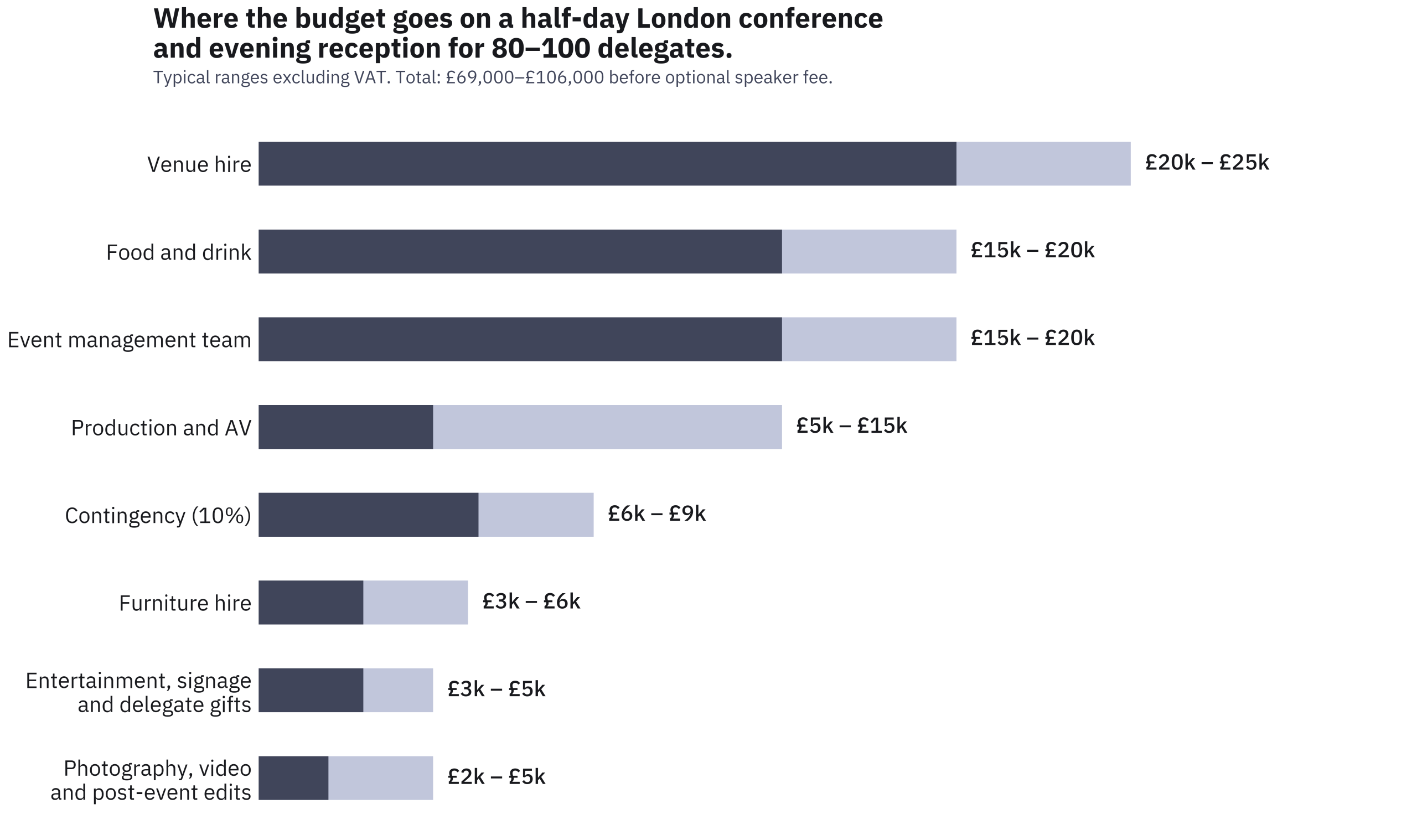
Where the budget goes on a half day London conference and evening reception for 80 to 100 delegates.
Not every event needs a production budget. A half day strategy workshop with a private dinner afterwards is one of the most common briefs we get, and it is a useful counterweight to the numbers above.
Venue hire for a good meeting room and a private dining space at a central London hotel or members’ club is approximately £2,000 to £4,000 for the day. Some venues will waive or reduce the room hire if your food and beverage spend hits a minimum, which for a group of 40 it is likely to.
Catering is where the per-head cost remains stubbornly high. Tea and coffee on arrival, a working lunch, afternoon refreshments, then a three-course dinner with wine — expect £3,500 to £6,000 depending on the venue and how good the wine list is. Service charges typically add another 10 to 15%.
Basic AV, a screen, sound and a technician on hand, runs £1,500 to £3,000. If you are recording the session or running a hybrid element with remote participants, it goes up. Half a day of photography is £400 to £800. Branding, printed materials and signage sit around £500 to £1,500, and delegate gifts another £600 to £1,200. Event management for a project of this size is £3,500 to £6,000.
The management cost is where smaller events can feel disproportionate. You still need someone to source and appoint the venue and suppliers, manage the contracts, coordinate the logistics, brief the catering team, run the AV check, and be on site all day to make sure everything lands. The work is different in scale to a large conference, but not in kind.
All in, a well-run workshop and dinner for 40 people comes to around £13,000 to £25,000 including contingency, or roughly £325 to £625 a head. Same care, same open book, different scale. If your budget looks more like this than the conference above, you are still very much our kind of client.
The same brief can produce very different budgets depending on where you deliver it, and many of our clients run events across several markets.
The UK sits in the upper middle range globally. London commands a 25 to 30% premium over other major UK cities, and a corporate conference in Birmingham or Manchester will typically cost 20 to 30% less than the equivalent in central London.
The US runs more expensive, particularly in New York, San Francisco and Los Angeles. A two day conference for 500 delegates in Chicago or San Francisco routinely hits $700 to $800 per head with accommodation. Freelance event managers charge more too, at $500 to $1,000 a day against £400 to £700 in the UK.
Continental Europe is mixed. Germany and the Nordics sit at or above UK levels. Southern and Eastern Europe, so Spain, Portugal and Poland, offer meaningfully lower costs for comparable quality, which is why they keep gaining ground for incentive travel and international conferences. A hotel conference in Barcelona or Lisbon can come in 20 to 40% below London.
The Middle East presents a paradox. Venues in Dubai and Abu Dhabi are often spectacular and competitively priced, sometimes with government subsidies to attract international events. Everything around the venue, so logistics, material imports and labour during peak season, can push totals higher than expected.
Asia Pacific is the fastest growing corporate events market. Singapore and Hong Kong are expensive but offer exceptional infrastructure. Southeast Asia, so Bangkok, Kuala Lumpur and Ho Chi Minh City, offers high quality venues and services at a fraction of London prices.
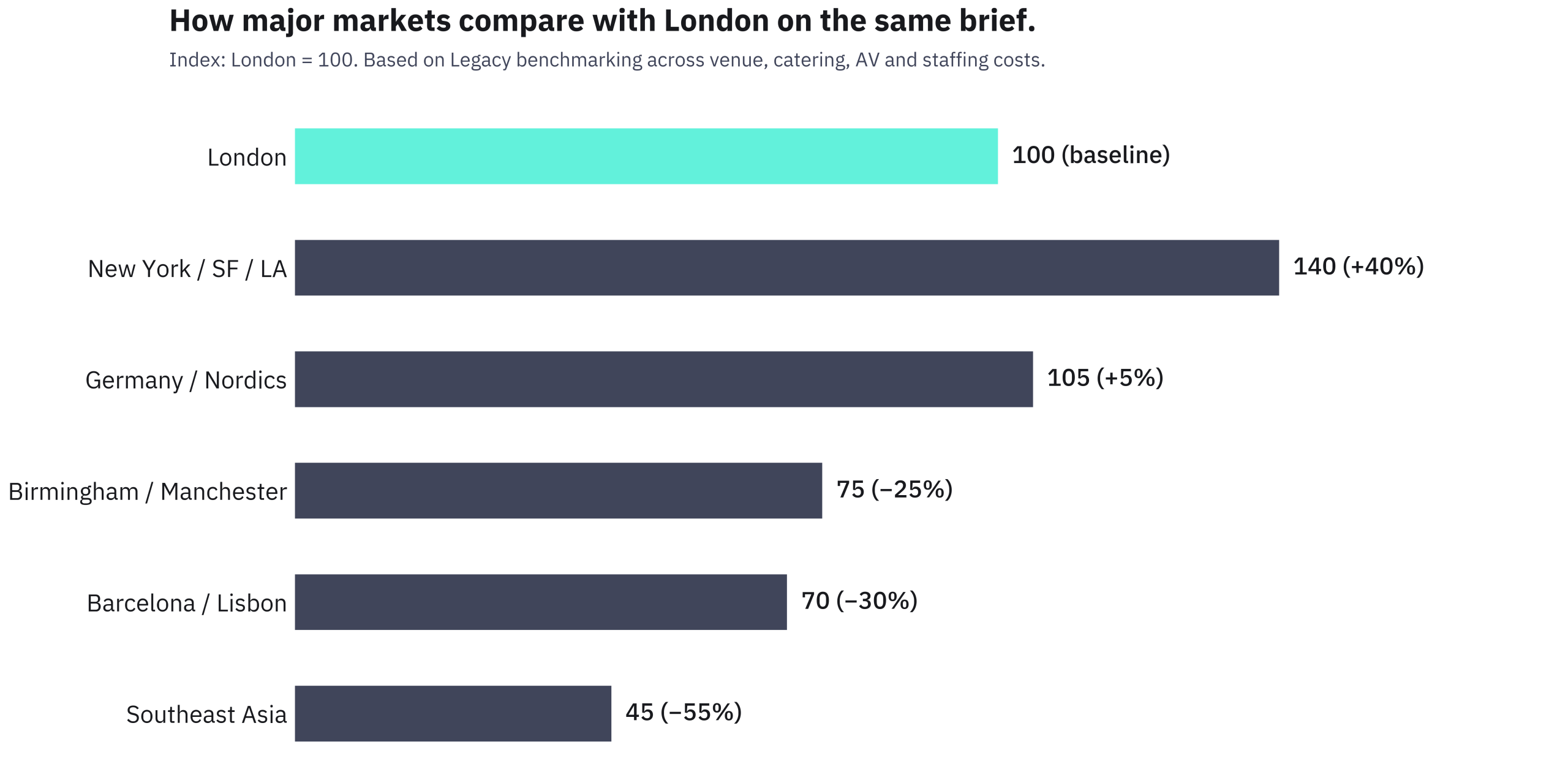
How major markets compare with London on the same brief.
One factor that clients rarely see is the venue commission model. In some markets, and Mexico is a useful example, agencies routinely pay venue commissions of 30 to 50% to be the in house preferred supplier, and that commission gets billed to the client. An agency that avoids exclusive venue contracts can be significantly more competitive without cutting corners. We have seen this through our own network. The same event can vary by 40% or more depending on whether venue commissions are in play.
Behind every event agency is a network of freelancers, and their rates tell you a lot about the real cost structure of events.
In the UK, freelance event managers charge £200 to £500 a day for coordination roles, rising to £350 to £700 for senior production managers running the whole show. Very senior people, with credits at Cannes Lions, Davos or the Olympics, can reach £700 to £900. Specialist rates vary. An experienced event photographer is £400 to £950 a day, videography with full kit is £400 to £850, and a creative or spatial designer is around £500.
In the US the floor is higher. Experienced producers charge $500 to $900 a day, with top tier people in New York or Los Angeles at $900 to $1,000 for a ten hour day. Registration and technology specialists start around $400, though someone who has run Cvent badging for a 5,000 person conference is a very different hire to someone who has set up an Eventbrite page.
European freelancers outside the UK tend to be more affordable. An experienced photographer in Poland charges around 2,500 PLN a day, roughly £500, and in Germany around €800. Wherever we hire, we pay the local professional rate rather than the lowest rate we can find, because a freelancer who feels underpaid on day one is not the person you want holding your show together on day three.
All of which raises a fair question: if these people are freelance, why not hire them directly? You can, and for a single straightforward event you might well be better off doing exactly that. What the agency layer buys you is the bit that happens before and between the day rates. Knowing which of those photographers is right for your room. Holding the contracts, the insurance and the risk assessments. Having someone who has already had the argument with the venue about load in times, so you do not have to. On a £100,000 event, that judgement is the difference between a good day and an expensive one.
The headline price of an event is almost never the final price. Industry research suggests around two thirds of event planners see budget overruns, averaging about 20%. These are not random. They cluster in predictable places.
Venue service charges are the most common surprise. Catering service charges of 10 to 20% are standard, and some venues stack a separate admin or facility charge on top. In the UK, VAT at 20% applies to nearly everything even though the service is usually quoted exclusive. On a £100,000 event, that is £20,000 you may not have budgeted for.
In house AV is another area where costs climb. Many venues mandate their preferred supplier, which typically comes with a 20 to 30% service charge plus patch fees, rigging charges and penalties for bringing in outside equipment. The in house model is built on revenue sharing between the AV supplier and the venue. It is a legitimate arrangement, but one where the economic incentive runs with the venue, not with you.
Insurance is the line people forget until a venue asks for it. Most UK venues require public liability cover of £5m to £10m before they will let you through the door, and for a single corporate event that is usually a few hundred pounds. Cancellation and abandonment cover, which pays out if the event cannot go ahead, is the one worth thinking harder about, and it typically costs 1 to 3% of the spend you are insuring. On a £100,000 event that is £1,000 to £3,000 to protect the lot. Check whether your agency carries its own cover, whether that extends to your event, and what is excluded.
If you are running an event abroad, local taxes will move your budget in ways a UK spreadsheet does not anticipate. Many European cities charge a tourist or city tax per delegate per night, either a flat amount or a percentage of the room rate, and Amsterdam, Barcelona, Paris and Rome all apply some version of it. US venues typically add sales tax, occupancy tax and a mandatory gratuity on top of the quoted rate, which can add 25 to 35% to a catering line. And if you are paying a speaker who is not tax resident where the event takes place, withholding tax may apply to their fee. None of this is difficult to plan for, but all of it is expensive to discover late.
Then there are the costs that never appear on an invoice. We once had a client give one portion of the production to another supplier, who had offered a discount in exchange for displaying their own marketing material at the event. The saving was real. So was the effect on the room, and on how the event landed with the audience. Sometimes the cheapest line on the budget is the one that costs you the most.
We sit in the middle of the market on purpose. That is not code for cheap, and it is not false modesty. It means a high quality of service at a price point that does not require a Fortune 500 budget to reach, and it means we would rather tell you that your budget does not stretch to the event you have described than take the brief and quietly water it down.
Clients sometimes look at an events agency management fee and wonder whether they could do the work themselves. They probably could — but they also have day jobs to focus on and there is no substitute for the experience and foresight that comes from years of doing this under pressure. We recently managed a grantee retreat for an international NGO client: bringing 75 people from the US, Latin America, and Africa to convene for four days at a resort in Canada. The client had never run a retreat before. We found the venue, booked cross-continental travel for every attendee, and coordinated accommodation, AV, catering, security, and facilitation. Then the Middle East conflict escalated, flights were rerouted, visas became last-minute scrambles, and bookings were cancelled. We dealt with all of it while the client focused on their programme.
We also work on an open book basis. Our clients see every cost. When we say a supplier charges £5,000, you can see that is what they charge. When we recommend a more expensive option, you can see exactly what the difference buys you.
This varies enormously. Some agencies treat sustainability as a premium add on, a separate line item on the budget. Some apply a mandatory sustainability fee or levy to every project, sometimes as a fixed percentage, covering carbon measurement, reporting and offsetting. In practice that means you are paying for sustainability whether or not the agency is doing anything particularly rigorous, and you may have limited visibility into what the fee actually funds. At the other end, plenty of agencies do nothing at all and hope nobody asks.
We sit somewhere more straightforward. Every member of our team is trained in sustainable event management. We source local suppliers, audit venues for their environmental credentials, and trial new products and services as standard practice. We do not charge extra for any of this. It is included in our management fees, because we think it should be a baseline, in the same way you would not expect to pay extra for an event that was legally compliant and had proper health and safety provisions.
There are specialist services that go well beyond standard good practice, and those are priced separately. A full sustainability assessment, detailed carbon calculations, verified offsetting or ISO 20121 certification is consultancy level work. We offer it through a dedicated strategy workstream that includes training and advisory services for organisations wanting to embed sustainability into their events programme properly.
If you are comparing proposals, here is what we would suggest looking for.
Ask for a fully itemised budget, with every cost broken out rather than a lump sum. An unusually low bid is often not a bargain. It is a list of things that have been left out. Check whether the quote includes VAT, service charges and AV, or whether those will turn up later as additional costs. Ask whether the agency receives a commission from the venue and what happens to it.
Meet the people who will actually deliver your event, not the ones who pitch for the business. Sales pitch and vanish is one of the most common complaints in the industry, where senior people win the brief and junior staff run the event. Ask who your day to day contact will be.
And if the budget is tight, think carefully about where you compromise. Reduce headcount, simplify catering, or drop unused technology before you cut production. The most expensive event is the one that does not achieve what it was supposed to.
Most charge 10 to 20% of the total event budget, a fixed project fee, or a day rate of £450 to £700 for a senior event manager. Retainers and hourly consultancy rates are also common.
A half day conference and evening reception for 80 to 100 delegates at a quality London venue costs roughly £69,000 to £106,000 excluding VAT, or about £800 to £1,200 a head. A headline speaker adds £10,000 to £12,000.
There is no hard floor, but below roughly £15,000 the agency fee starts to take a large share of a small budget, and you may get better value hiring a freelance event manager directly. We will tell you honestly if that is the case.
Yes. A comparable conference in Birmingham or Manchester typically costs 20 to 30% less than central London. Barcelona or Lisbon can be 20 to 40% lower again.
VAT, catering service charges, in house AV surcharges, insurance, and local taxes such as city or tourist tax on overseas events. Together these can add 20% or more to a headline figure.
Every event is different, and so is every budget. If you have a brief and a number in your head and you are not sure whether the two match, send it over. We will give you an honest read on what it will really cost and what we would change, whether or not we end up being the right agency for the job.
Get in touch →
Written by real people at Legacy, with an AI assistant helping to wrangle the research and tidy the prose. The opinions and the numbers are ours. So are any mistakes.