

Written by the Legacy Events Group team. Last updated August 2026.
The short answer.
Most event merchandise fails because it is cheap, over branded, or duplicates something every delegate already owns. The stuff that survives the journey home is useful, well made, and discreetly branded, and it usually costs between £4 and £15 a unit rather than 30p. Before you order anything, work out whether you need to give anything away at all. Sometimes the best merchandise budget is the one you spend on a charitable donation, or on the stand itself.
Where these numbers come from. Costs in this article come from Legacy’s own sourcing and benchmarking research, drawn from live supplier quotes and events we have delivered. They are indicative ranges rather than quotes, and correct as of August 2026.
UK organisations spend over £1 billion a year on promotional merchandise. A significant proportion of it ends up in landfill within weeks. Branded stress balls. Foam mouse pads. Cheap water bottles that leak. Tote bags so abundant that most of us have a bag full of bags. Organisations clearly see some brand value in giving things away. They are just giving away the wrong things.
We should be upfront about something. We run a sustainable merchandise platform, which makes us an unlikely source for the argument that you should buy less merchandise. That is rather the point. We would rather sell you two hundred things people keep than two thousand things they leave in a hotel room.
If you have spent £150,000 to exhibit at a major event, start by asking whether the table needs anything on it. Sometimes the better move is to put all of the budget into a stand people want to stand in, decent coffee, and a clever backdrop. Sometimes nothing is the right answer.
Here is the honest test. If the item you are considering would end up in a hotel bin on the last morning of the conference, it should not be in the budget.
Merchandise works when people want to keep it. That sounds obvious, but it rules out most of what gets handed out at trade shows.
The items that survive the journey home share a few things. They are useful. They are well made. And the branding is subtle enough that you would use them in front of a client without feeling like a walking advert.
Take pens. Not the 30p ballpoint that skips on the first line, but a pen that writes well and feels solid in the hand. At around £4 a unit, a quality pen stays on someone’s desk for months. People do not just look for their pen. They look for your pen. The cost per impression is hard to beat.
The same goes for branded notebooks, packing cubes, toiletry bags, good socks, sunglasses, and, less obviously, luggage scales, suitcase handle sleeves and reusable gel ice packs. These solve a real problem for someone who travels regularly. They get packed, used and repacked.
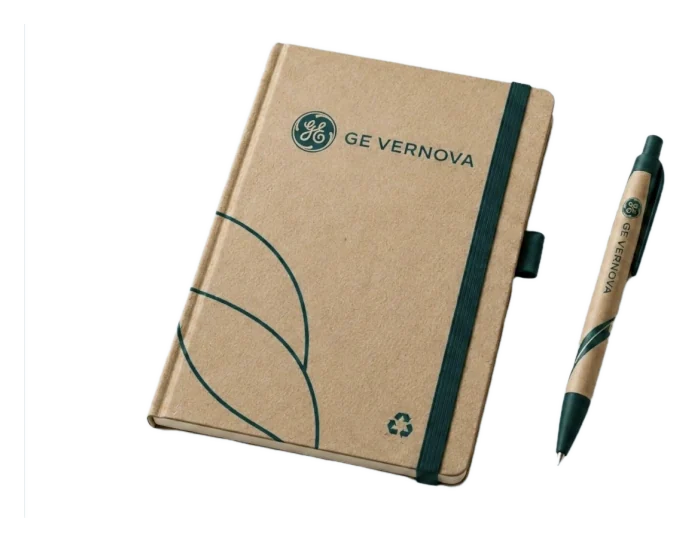
A recycled paper notebook and pen for GE Vernova. Useful, well made, and branded quietly enough for a client meeting.
What does not work: anything ordered in bulk without being tested first. Anything with a logo so large it becomes unwearable. Anything that duplicates something every delegate already owns ten of. And anything that does not fit in hand luggage, because if it cannot travel home, it will not.
The gap between forgettable and kept is usually a few pounds a unit. Here is roughly what the options cost and what tends to become of them.
| Item. | Unit cost. | What usually happens to it. |
| Basic promotional pen. | £0.30 to £0.60 | Lost or binned within days. |
| Pen that actually writes well. | £3.50 to £5.00 | Stays on a desk for months. |
| Recycled paper notebook. | £4 to £8 | Used if the branding is discreet. |
| Bamboo socks, ethical supplier. | £7 to £9 | Worn, and talked about. |
| Reusable stainless steel cup. | £8 to £14 | Kept, if it is genuinely good. |
| Branded mid layer or quarter zip. | £30 to £45 | Worn for years, or never once. |
| Charity donation per delegate. | £3 to £10 | Remembered. Nothing to ship. |
The arithmetic that matters is not unit cost, it is cost per impression. Five hundred cheap pens at 40p is £200 for a few hundred glances and a bin bag. Two hundred good pens at £4 is £800 for two hundred desks, seen daily, for the better part of a year. The second option costs four times as much and is considerably better value. Ordering fewer, better things is almost always the right call.
This deserves its own section because it is where so many organisations get it wrong. A big logo makes every useful item unusable.
The merchandise that gets kept is the stuff that looks like something you would buy yourself. A quarter zip with the logo on the inside placket. Sunglasses with branding only on the microfibre cloth. Notebooks where the brand mark is discreet enough for a client meeting. The goal is to remind people of you every time they reach for it, not to turn them into unpaid advertising.
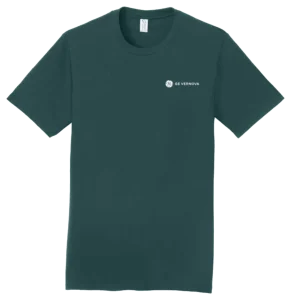
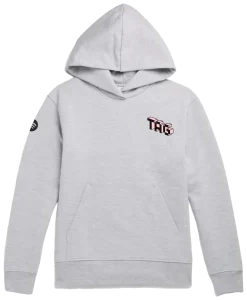
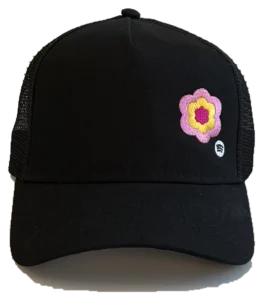
Branding people will actually wear: a GE Vernova t-shirt, a TAG hoodie for Spotify with the logo on the sleeve, and a Spotify trucker cap.
Apparel is the single biggest source of merchandise waste, and the cause is nearly always the same. Someone guesses a size distribution, orders to a bell curve, and ends up with forty extra smalls and no extra large. Collect sizes at registration and order to actual demand. It takes one extra field on a form, it costs nothing, and it removes the most predictable pile of leftover stock in the industry.
For organisations that do choose merchandise, sustainability should be part of the decision rather than a badge added afterwards. Get it right and you reinforce your values. Get it wrong and you undermine them. A few principles hold consistently.
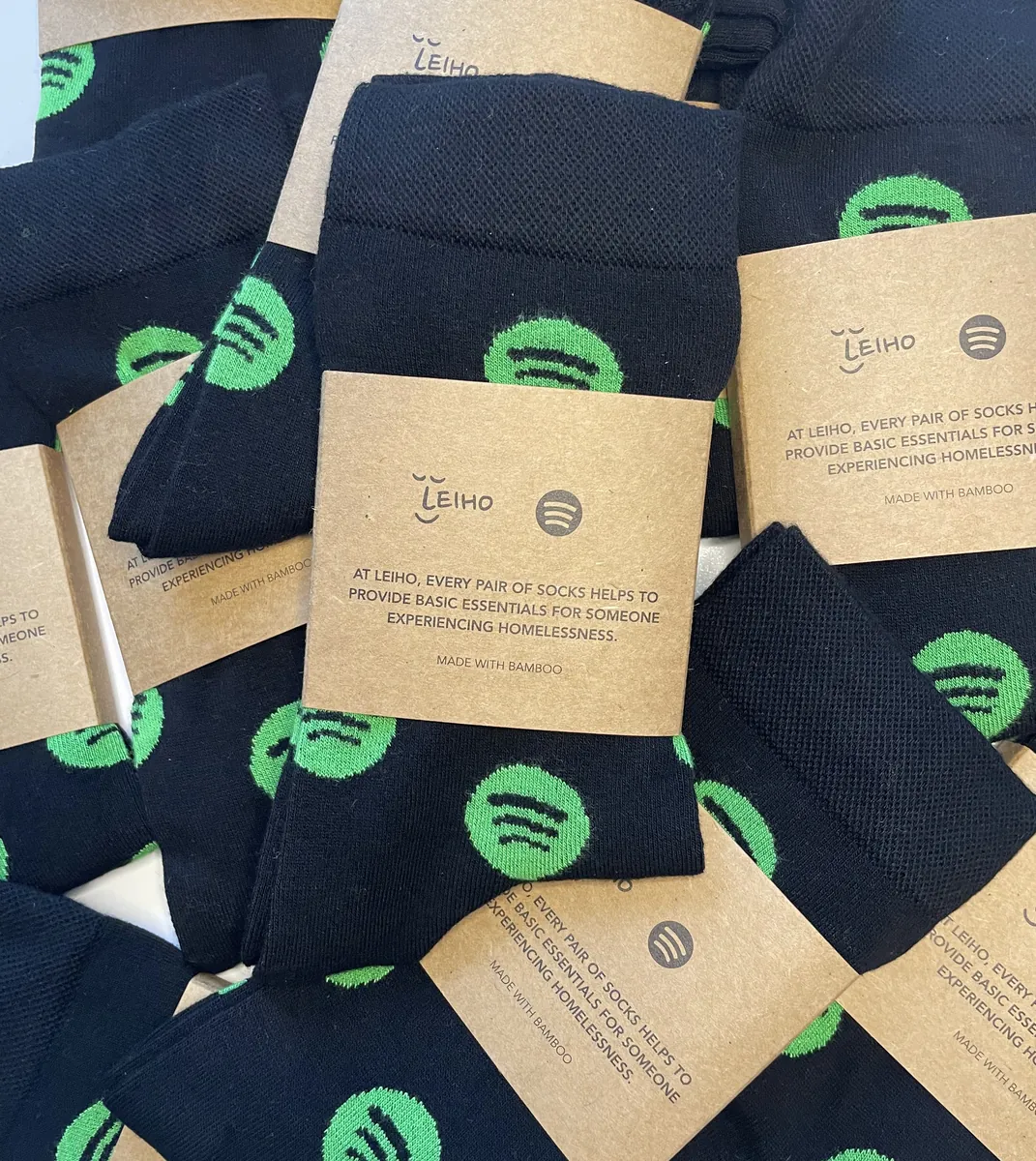
For QCTip 2026, an international quantum computing conference we are delivering with the University of Oxford, we sourced bamboo socks from a UK company that uses natural materials, runs independent factory audits, and operates a buy one, donate one model. Each pair purchased means a pair donated to someone experiencing homelessness. The unit cost was £8.15. Not dramatically more than a forgettable pen, but with a story that gives delegates something to talk about.
Reusable cups made from recycled stainless steel. Paper lanyards from tear resistant Kraft paper. Seeded name badges printed on paper that grow wildflowers. These are practical items that avoid the bin.

A reusable steel cup for QCTiP, built to outlast the conference.
A word of caution on anything seed based, though, and it is one we learned the hard way. Seeds do not always germinate, and biosecurity restrictions in countries such as Australia and New Zealand can mean they are confiscated at the border. A delegate having their conference badge taken off them at customs is not the brand memory anyone was hoping for. Know where your audience is flying home to.
An international academic conference calls for something different from a technology trade show in Las Vegas. For QCTip, we proposed socks featuring a quantum computing equation around the lower part of the sock. Playful enough to be a talking point, relevant enough to feel considered, useful enough to actually wear. For keynote speakers, a branded mug paired with a social enterprise snack box: lentil chips, vegan flapjacks, a fair trade sparkling drink and vegan fudge. Thoughtful without being extravagant.
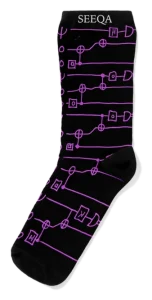
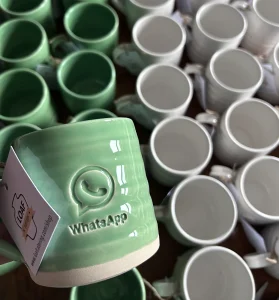
Matched to the audience: a quantum circuit sock design for SEEQA, and handmade mugs from social enterprise Loaf Pottery for WhatsApp.
Most organisations have no system for tracking what happens to merchandise after it is ordered. Stock sits in boxes across several offices, gets reordered unnecessarily, and generates waste that nobody measures. The two hundred items that did not get handed out are not a rounding error. They are next year’s budget, sitting in a cupboard.
There are only really three good answers. Redistribute the stock to another event, donate it to an organisation that can use it, or hold it in managed storage with a proper record of what you have. The one bad answer, which is also the most common, is to leave it in a cupboard and order more next time.
This is the problem Legacy Marketplace exists to solve. It is our sustainable merchandise management platform. It tracks stock levels across locations, handles check in and check out so you know what you actually have before you reorder, and generates the sustainability data you will need when somebody asks what your merchandise programme cost the planet. It turns merchandise from a hidden cost into a managed asset.
There is a growing case for dropping merchandise altogether in favour of charitable donations. Some organisations have replaced trade show giveaways with a simple mechanic: scan your badge, choose one of three small local charities, and the company donates on your behalf.
What we have seen reported is encouraging. Post event follow up emails tend to see higher open rates, and conversations at the stand last longer, because there is something to talk about beyond the product.
The logistics also become dramatically simpler. No storage, no shipping, no leftover boxes, no agonising over sizes. It works particularly well when the charities are small and local to the event destination, giving delegates a real sense of connection to the place they have travelled to. The logistics of doing nothing well are considerably simpler than the logistics of doing something mediocre.
Merchandise is really a proxy for a bigger question. Have you thought carefully enough about what your delegates will value, what fits your organisation’s principles, and whether the money could work harder somewhere else?
Worth asking before you order anything.
The best merchandise is the kind that stays. The best events are the kind that earn their place. The two are more connected than most people think.
Between £4 and £15 a head for something that gets kept, or nothing at all. The middle ground, a pound or two on an item nobody wants, is the only genuinely wasted spend.
Something useful, well made and discreetly branded that fits in hand luggage. A good pen, a decent notebook, socks, or a reusable cup. Or a charitable donation triggered by a badge scan.
They are, with one caveat. Seeds do not always germinate, and countries including Australia and New Zealand may confiscate them at the border. Check where your delegates are travelling from.
Redistribute it to another event, donate it to an organisation that can use it, or hold it in tracked storage so it is not reordered unnecessarily. Do not leave it in a cupboard.
Cheap merchandise is. Fewer, better items from audited suppliers, ordered to actual demand and tracked afterwards, has a much smaller footprint than the usual bulk order.
Not sure whether your next event needs merchandise at all? Tell us what you are planning and we will give you a straight answer, even if the answer is nothing.
See how Legacy Marketplace works →
Written by real people at Legacy, with an AI assistant helping to wrangle the research and tidy the prose. The opinions and the numbers are ours. So are any mistakes.