

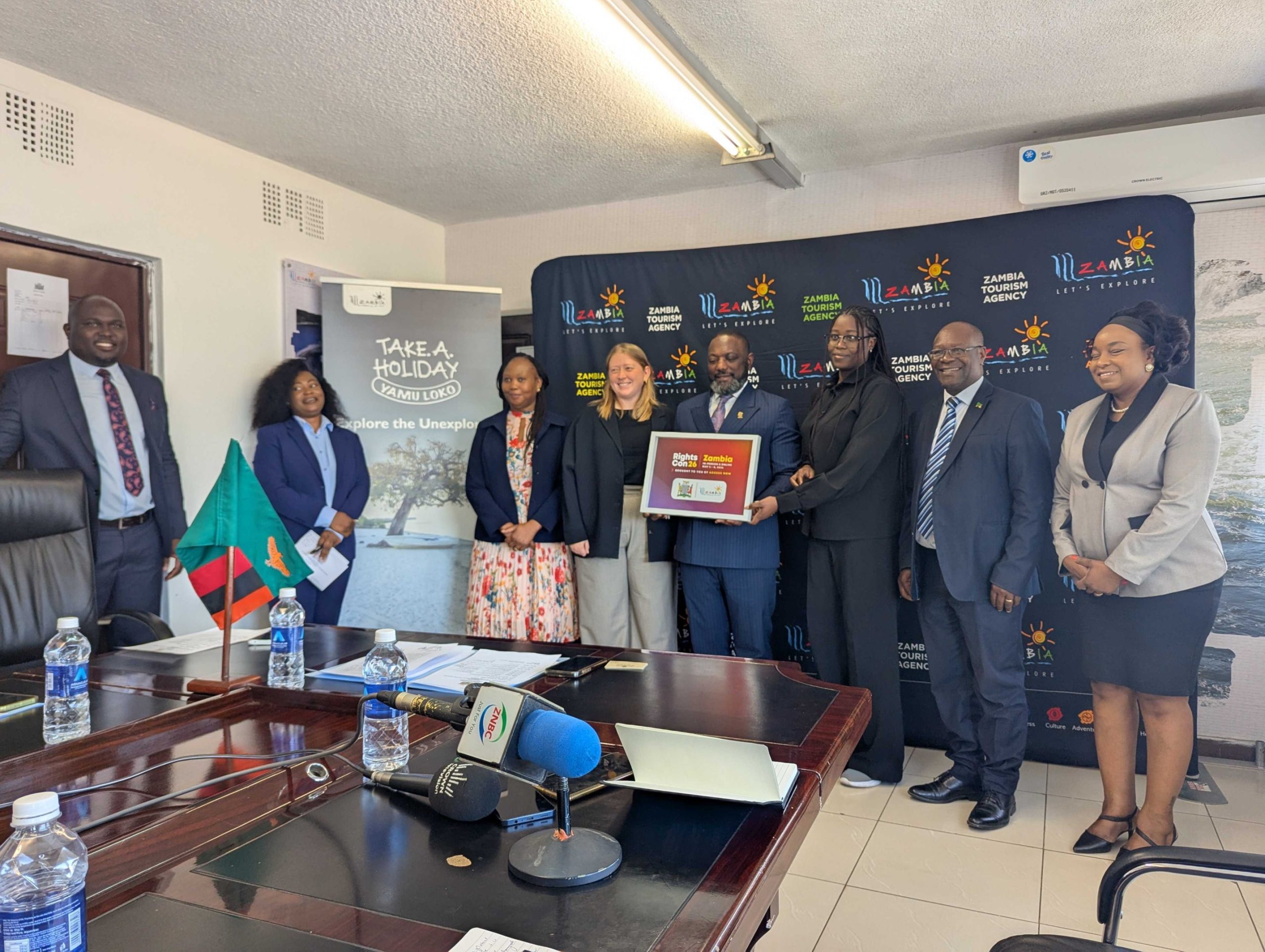
When Legacy came on board as production partner for RightsCon last autumn, the destination had already been chosen. Lusaka, Zambia was selected by our client, Access Now, after a multi-year process for its extraordinary visa accessibility, its emerging civil society scene, and a signed partnership with the Zambian government.
Our job was to make it work. We spent months in discussion with the venue to optimise the spaces and catering, negotiating with suppliers, building relationships with local civil society, sweating the thousand logistical details that turn a conference centre into a functioning gathering for thousands of human rights defenders from 150 countries.
Then, five days before doors were due to open, it all fell apart.
On 27 April, Access Now learned that Chinese diplomats were pressuring the Zambian government to exclude Taiwanese participants. Within 72 hours, a post on a government backed Facebook account announced a “postponement,” without consulting the organisers. By 1 May, Access Now confirmed that RightsCon would not go ahead in Lusaka or online. They rightly refused to moderate content or ban communities at the demand of a foreign government.
The decision to cancel was not taken lightly. All of the senior members of the organising team were in constant communication as the situation deteriorated, weighing the safety of delegates against the mission of RightsCon and the enormous investment that had brought us to that point.
We were gutted. So was the community. Around 2,600 people were due to attend and had made travel preparations. Over 550 sessions had been programmed. Local civil society organisations, many preparing for their first RightsCon, had invested months of work that simply evaporated. As Luisa Ortiz Pérez of Vita-Activa.org put it, the damage was “deeply human.”
But if the experience broke our hearts, it also sharpened our thinking. We produce events for organisations working in social justice, development and human rights, for the Ford Foundation, Luminate, Access Now and others. What Lusaka taught us is that in this new world that we are operating in, choosing where to gather is a political decision with logistical consequences. Getting it wrong doesn’t just waste money. It puts people at risk.
This post is our attempt to share what we’ve learned, from this event and others over our ten years of organising events for clients around the world. A practical framework for choosing a destination that is safe, accessible and fit for purpose in 2027. We’ve organised it by event size, because the risks and trade-offs shift dramatically depending on whether you’re convening 30 people or 3,000.
Before getting into the specifics of scale, there are a handful of criteria that apply to every international gathering of people working in sensitive fields.
This means two things at once. First, personal safety: what are the crime rates, and what does daily life look like for a visitor who doesn’t know the city? Cape Town, for instance, has world-class conference infrastructure and Africa’s only constitutional LGBTQ+ protections, but it also has one of the highest violent crime rates of any major city on the continent, and delegates unfamiliar with the context need careful guidance on where to go, how to travel and what to avoid after dark. Bogotá and Mexico City present similar trade-offs. It’s easy to let a glossy convention bureau brochure obscure you to the reality of street-level safety.
Secondly, political safety. For any convening that includes LGBTQ+ delegates, and in the human rights and social justice space, that should be all of them, the legal status of homosexuality in the host country is a key filter. Malaysia, Ghana, Kenya, Uganda, Tanzania and Nigeria all criminalise same-sex conduct to varying degrees. Countries where homosexuality is legal but social acceptance is low (Rwanda, for example, where it was never criminalised but protections are thin) require a more nuanced conversation with your community.
The safest destinations on LGBTQ+ indices, Uruguay, Portugal, Spain, Iceland, tend to be in Europe or Latin America, which creates a tension with accessibility that we’ll come back to.
Visa policy is the single biggest determinant of who can and cannot attend your event. If your delegates are coming from the global south (and if they’re not, it’s worth asking why), then a Schengen visa requirement will exclude a significant proportion of them, regardless of what your bursary budget looks like. Refusal rates for African applicants applying for Schengen visas remain stubbornly high, and the process itself is expensive, slow and often humiliating.
Rwanda leads the field here: since 2018, all nationalities receive a visa on arrival, and African Union citizens enter free. Kenya has moved in a similar direction, with visa-free access for all African nationals and a quick electronic travel authorisation for everyone else. Georgia offers visa-free entry for over 90 nationalities and accepts holders of valid US, EU or UK visas, though its democratic trajectory (more on which below) now makes it unsuitable for rights-focused events.
And a painful footnote for 2027 specifically: if any of your US-based delegates hold dual nationality or green cards, particularly from countries in the Middle East or Africa, they may face enhanced screening, device searches and questioning on return to the United States. The travel restriction list expanded to 39 countries in December 2025, and while green card holders are legally entitled to return, the practical experience at the border has become considerably less predictable. Build robust remote participation options, and advise affected delegates to seek legal guidance before travelling.
Flight connectivity matters more than people think. A destination that requires three connections from Nairobi or Lagos is not “globally accessible” just because it has a conference centre. Istanbul and Dubai are the great equaliser hubs. Turkish Airlines alone serves 133 countries from a single hub, including 65 points in Africa. Johannesburg and Addis Ababa are strong hubs on the African continent. Bangkok, Kuala Lumpur and Seoul serve Asia-Pacific well with onward links. Latin American cities, by contrast, tend to be poorly connected to Africa and Asia, which is a real cost for a truly global convening even if the destination is otherwise ideal.
For anyone working in social justice, development or civic space, digital security is not a nice-to-have. Does the host country conduct mass surveillance? Is encryption legal? Can delegates use Signal, WhatsApp and VPNs without restriction? Some countries have invested heavily in Chinese-built surveillance infrastructure, something worth weighing carefully if your delegates work on issues those systems were designed to suppress. Others routinely search devices at the border, a serious concern if your delegates are carrying sensitive contacts or case materials. Related to this, check internet reliability: if your event has a hybrid component, you need bandwidth you can trust and a host country that doesn’t throttle or block encrypted services around politically sensitive moments.
Are there international-standard healthcare facilities within reach of your venue? Is the destination a malaria zone, and have you communicated that clearly enough and early enough for delegates to arrange prophylaxis? Crucially, are specific medications available and legal? For example, HIV antiretrovirals and certain contraceptives are restricted or difficult to obtain in some countries. This extends to accessibility more broadly: wheelchair access at the venue and hotels, accessible transport, and whether the city’s infrastructure meets basic disability standards. Too many events treat accessibility as an afterthought and then discover, three days before opening, that the main plenary room is up a flight of stairs.
This sounds mundane, but it isn’t. Bangkok in April is 35°C and suffocating. The Caribbean hurricane season runs June to November. West Africa’s rainy season, from June to September in most coastal cities, can make city transport unreliable for weeks. Extreme heat is a health risk for delegates with chronic conditions, and it limits the informal networking that happens outside the venue. Check the climate window before you fall in love with the destination.
NGO budgets are tight and getting tighter. A week in Geneva versus a week in Kigali is a fundamentally different financial proposition, and for organisations funding delegates from the global south, the per diem rate of the host city directly determines how many people can attend. Cost is an equity issue dressed up as a logistics one.
There is no way around the fact that flying hundreds or thousands of people to a single city has a significant environmental footprint. A well-connected hub that most attendees can reach on a single flight produces materially less carbon than a city that requires double connections from half the world. This is another reason to take flight connectivity seriously: accessibility and sustainability pull in the same direction. It also strengthens the case for robust hybrid participation as a core part of how the event is designed, reducing the number of flights without reducing the quality of engagement.
When you register hundreds or thousands of delegates, you’re collecting passport numbers, nationalities, organisational affiliations and contact details. In many countries, that data passes through local systems – hotel registration cards, immigration databases, venue security checks. What are the host country’s data protection laws? Who has access? For delegates from repressive states attending a human rights event, a leaked registration list is a scenario you need to plan for.
At this scale, you’re likely running a retreat, a strategy session, a working group. The dynamics are fundamentally different from a large conference. You’re unlikely to attract the attention of a host government, which means the political risk profile is lower. Nobody is sending diplomatic cables about a 40-person workshop.
What matters most here is personal safety, accommodation quality and ease of access for a relatively small group of known participants. You can afford to be more adventurous with your destination because the logistical tail is shorter and the political footprint is lighter.
Montevideo is hard to beat at this scale. It’s the safest city in South America, marriage equality has been law since 2013, accommodation is good and affordable, and the city is compact and walkable.
Lisbon works beautifully for a small group (the Schengen visa barrier is more manageable when you’re dealing with 40 applications rather than 400).
San José, Costa Rica, is pleasant and relatively well connected to the Americas, though be warned: Access Now’s experience at RightsCon Costa Rica in 2023, where many participants were denied entry at the border despite agreed visa-on-arrival arrangements, should give anyone pause about relying on informal government assurances.
Tirana, Albania, is an emerging option worth exploring. Visa-free for most nationalities, very affordable, and with a growing hospitality infrastructure. Homosexuality is legal, though social acceptance is limited and protections are thin. It won’t suit every community, but for a small, lower-profile gathering it offers good value and an interesting setting.
Crime in cities that are otherwise lovely (Cape Town, Bogotá). Accommodation outside the capital in smaller countries can drop off sharply in quality, always carry out an in-person site-visit. Even at this scale, check whether any of your participants face specific risks in the host country because of their nationality, sexuality or field of work.
At this scale, you need a proper venue, a decent hotel stock within reasonable distance, and reliable local suppliers. You’re also becoming visible enough that the host context matters more, not necessarily at the level of government interference, but in terms of local media attention, police presence around your venue, and the experience your delegates have moving through the city.
Cape Town is strong here. The CTICC can accommodate this size comfortably, the hotel stock around the Foreshore and Waterfront is good, and the city’s convention bureau is experienced. Crime remains the caveat, budget for dedicated transport, clear delegate guidance and a security presence at your venue and hotels.
Taipei hosted RightsCon successfully in 2025 and it was rated ‘Free’ by Freedom House, safe, and well served by an international airport with direct flights across Asia, Europe and North America. with strong venue infrastructure. The geopolitical sensitivity around Taiwan and China should be noted as it was, after all, the participation of Taiwanese delegates that triggered the Lusaka crisis, but Taipei itself is a proven and welcoming host.
Buenos Aires is a strong contender at this scale. Argentina is rated “Free” by Freedom House and was the first country in Latin America to legalise same-sex marriage, in 2010. The new Centro de Convenciones Buenos Aires has capacity for 5,000 people and was designed with sustainability in mind. The city is safer than Rio or Cape Town, more affordable than most European alternatives, and has a deep bench of local civil society organisations. The downsides are poor flight connectivity to Africa and Asia and Argentina’s economic volatility, which can make budgeting unpredictable.
Kigali works well logistically (the Kigali Convention Centre is excellent and the city is remarkably clean and safe), but Rwanda’s “Not Free” rating from Freedom House creates a tension for a human rights event. Do host there, but go in with your eyes open about the optics and the risks, and have a frank internal conversation about whether your organisation is comfortable with the trade-off.
Hotel stock constraints in smaller cities (Kigali and Montevideo both have limited international-standard rooms). The 2027 election calendar. Kenya’s general election is scheduled for 10 August 2027, so avoid Nairobi from roughly June to September. And at this scale, start thinking about your relationship with local authorities: not a formal MoU necessarily, but at minimum an understanding with the police about your event and its participants.
At this scale, your event will be noticed by the host government, by foreign embassies and by local media. If your programme touches on anything sensitive, you need a host government that is not merely tolerant but actively committed to protecting your right to convene.
The Lusaka collapse demonstrated that this commitment is the most fragile variable in the entire equation. Zambia had been chosen specifically for its accessibility: 167 nationalities could enter visa-free. The government had signed agreements, held press conferences, done site visits with the organisers. And none of it mattered when a more powerful actor applied pressure.
The lesson is not “don’t go to Africa. The lesson is that a signed agreement with a ministry is necessary but not sufficient. You need to assess the host government’s resilience to external pressure, particularly from China, which has significant diplomatic and economic leverage across much of Africa and southeast Asia. You need a contingency plan that includes a fall-back venue in a second country and a fully-built hybrid platform. And you need the written commitments to be public, senior-level and specific: not just “we welcome your event” but “we guarantee non-interference in your programme, your participant list and your content.”
Cape Town is the strongest all-round pick for a large, LGBTQ-inclusive conference in Africa. South Africa is rated “Free” by Freedom House, has constitutional LGBTQ+ protections unique on the continent, and the CTICC can handle up to 10,000 people theatre-style. The crime issue is real and manageable with proper planning; dedicated shuttle routes, a security operations centre, clear no-go guidance, and coordination with local police. It’s also worth noting that South Africa has historically maintained an independent foreign policy that makes it less susceptible to the kind of bilateral pressure that sank the Lusaka event, though this is a judgment call rather than a guarantee.
Bangkok has superb infrastructure, the rebuilt Queen Sirikit National Convention Center handles up to 6,000 attendees, and Thailand passed marriage equality in January 2025. But Thailand has a documented history of deporting activists under Chinese pressure (Joshua Wong in 2016, bookseller Gui Minhai abducted in 2015), which makes it a poor choice for any programme that touches on China or Taiwan.
Seoul is a solid, lower-risk option with proven form. Bogotá’s Ágora convention centre is world-class (capacity 4,000+), but Colombia now requires visas for all African nationals, which significantly undermines accessibility.
Mexico City deserves serious consideration at this scale. Mexico City has had marriage equality since 2009, and the city’s conference infrastructure is mature and well supported. Mexico is rated “Partly Free” by Freedom House rather than “Free,” and crime is a real concern, though it is neighbourhood-dependent and manageable in the Polanco and Reforma corridors where most conference hotels and venues sit. The visa picture is more nuanced: while most sub-Saharan African nationals technically need visas, holders of a valid US, Schengen, UK, Canadian or Japanese visa are exempt, which in practice covers a significant proportion of NGO delegates who already hold one of these for other travel. Note that Mexico has legislative elections scheduled for 6 June 2027 so avoid that window.
Everything mentioned above, plus the sheer logistical complexity of a 1,000+ person event in a city you don’t know well. At this scale, the operational footprint of the event itself becomes significant, catering for a thousand people, waste from a week of sessions, energy consumption across a large venue. Increasingly, funders expect to see sustainability addressed in event budgets. Ask whether the convention centre has green certifications, whether local catering can be sourced sustainably, and what the waste management looks like. These questions are easier to answer well in some cities than others.
Think seriously about event cancellation insurance: can you get adequate coverage, what does the policy actually exclude, and what is your financial exposure if the whole thing collapses a week before doors open?
At this scale, you need a production partner with deep relationships, who can use their network of local suppliers, navigate the cultural ambiguities and produce contingency plans that work. (This is, not coincidentally, what we do.)
At this scale, your options narrow somewhat. You need a venue that can physically accommodate thousands of delegates, a city with enough hotel stock to absorb them, flight connectivity that doesn’t create a three-day travel ordeal for half your attendees, and a political environment stable enough to guarantee that the whole thing doesn’t unravel a week before it starts.
Very few cities tick every box. Cape Town’s CTICC is the standout in Africa. Bangkok’s QSNCC and Bogotá’s Ágora have the raw capacity. Lisbon has the Altice Arena (up to 20,000) and the FIL exhibition complex, but Schengen visas remain the obstacle. Kigali’s Convention Centre can stretch to about 2,600 in plenary, which puts it at the upper edge of this tier but not comfortably above it.
For a summit of this size, the host government relationship is critical. You will need visa facilitation at scale, customs clearances for equipment, police cooperation, and probably ministerial engagement. Which means you need a government that sees hosting your event as being in its interest, not just tolerable.
To be honest, there is no perfect city for a 2,000+ person, global convening in the social justice and development space in 2027. Every option involves a trade-off. Cape Town trades crime risk for political freedom and accessibility. Bangkok trades geopolitical exposure for infrastructure and connectivity. Lisbon and Montreal trade visa barriers for safety and rights. The job is to find a destination with risks you can manage, plan for the ones you can’t, and build the contingencies that keep your community safe when things go wrong.
Every time people working on social justice, human rights or development come together in the same room, whether it’s 30 people in Montevideo or 3,000 in Cape Town, they are doing something that powerful actors would often prefer they didn’t. If Lusaka taught us anything, it’s that the right destination isn’t the one with the best convention centre or the cheapest hotel rates. It’s the one where your community can do its work without looking over its shoulder. Finding that place takes research, relationships and, occasionally, a willingness to walk away. We’ve been through it. We can help you do it too.
Legacy is an event management company specialising in international convenings, including for organisations working in social justice, development and human rights. We were proud to serve as production partner for RightsCon 2026 in Lusaka. To discuss your next event, get in touch).